Eirball.Club – Aran Islands Cead and Traditional European Sports
Manx Cammag
Manx Cammag is a version of Hurling (or Caman in Irish) played in the Isle of Man, where Manx Gaelic was traditionally spoken. It is also very similar to the Scottish game of Shinty or Camanachd. The earliest mention of Hurling or Caman is in the Irish ‘Book of Leinster’ in the 12th Century AD. It played with a small ball and hooked stick. Kit Gawne, writing in his book, ‘Isle of Man Hockey’ suggests the game may have been introduced by missionaries, although the earliest mention in the Isle of Man records is not until 1760. [References: 2-3]1
It is a Winter Sport, with special matches arranged on St. Stephen’s Day (such as the one between North & South of the Island. There are few rules, and any number of players can play on either side, with coats or sticks marking goalposts. The ball is known as the “Crick” [References: 2-3]2
The match on St. Stephen’s Day between North & South is played in conjunction with the Festivities associated with the day, such as ‘Hunting the Wren’, although these days no wren is killed, and those making donations to charity are given a coloured ribbon, rather than a wren’s feather, supposed to bring good luck for the following year, thought to be particularly efficacious in the event of a shipwreck or witchcraft. [References: MC-1 to MC-3]3
Manx Cammag
Manx Cammag
2021: South won
2015: North won
2012: North won

Cornish Hurling
Every Shrove Tuesday in St. Columb’s, Cornwall, the game of Hurling is played between ‘Town’ and ‘Country’. The night before resembles a ghost town as all the shops are boarded up and shuttered before the game is played the next day. There are no limits to the numbers of players in the game, with each player playing for either the ‘Town’ or ‘Country’. The game kicks off with the words “Town and Country do your best. but in this parish I must rest.”.
Traditionally, the game was played between the men of St. Columb, but is now played by the children. [3] The Game can last a few minutes or it can last hours depending on how quickly the winning team can get the ball to the goal. The winning player who carries the ball to the goal has the option of keeping the ball and paying for a new one by a local craftsman. The ball is constructed traditionally, out of silver with an applewood core, taken from a local orchard.
Cornish Hurling
The Hurlers Bronze Age stone circle at Minions near Liskeard Cornwall England UK Europe – ian woolcock
Cornish Hurling (Hurling the Silver Ball):

Ba Game, Uppies & Downies and Shrovetide Football
According to later legend Celtic Britons played the Romans at a game of Football in Derbyshire on Shrove Tuesday AD 217 after a battle. These games of Football had no formal rules, or numbers per side and are also known as Medieval or Mob Football with the objective usually to get the ball back to a base at either your own teams end or the opposing teams. Variations on the theme include Uppies & Downies (those living up the hill versus those living down the hill) and Town versus Country. These sports are also known in Continental Europe. In Britain these days they are mainly played in the Celtic fringes of England and Scotland: Cornish Hurling in Cornwall, Manx Cammag in the Isle of Man, Orkney Ba Game in the Orkney Islands, Shaking the Hales in Northumberland, Uppies & Downies in Cumbria, and the Shrovetide Game in Derbyshire. Other games include Eton Fives, a version of Handball first played in the Middle Ages by Peasants against the Church Walls at Eton College, with a handrail providing an obstacle down one side.
Medieval British Football
Scottish Ba’ Game. English Shrovetide Football,
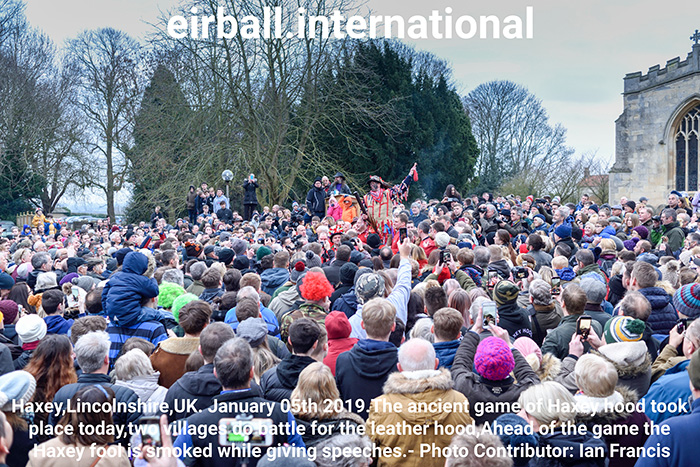
Royalty-free stock photo ID: 1275324475 Haxey,Lincolnshire,UK. January 05th 2019.The ancient game of Haxey hood took place today,two villages do battle for the leather hood,Ahead of the game the Haxey fool is smoked while giving speeches. By Ian Francis
Scottish Ba’ Game
English Shrovetide Football
Other English Football Games
Traditional European Baseball Codes
Versions of Baseball and Rounders are played throughout Northern and Northwestern Europe. Other than Rounders played in Britain and Ireland, Welsh Baseball (also known as English Baseball in Liverpool or British Baseball) is like a cross between Baseball, Rounders and Cricket. It is primarily played in South Wales and Liverpool. Other versions of Baseball include Pesäpallo, which is Finland’s National Sport and Brännboll, a traditional game of Sweden.
Welsh (British) Baseball
Welsh Baseball is a version of Rounders played primarily in South Wales, and also in Liverpool, where it is known as English Baseball. It is like a cross between Baseball, Rounders and Cricket. During the latter half of the 19th Century, the famous A.G. Spalding of Major League Baseball fame organised a Baseball Tour of England and Ireland, and in the process played a number of games against English and Welsh Rounders teams, who adopted some of the rules (such as tagging a playerout with the ball and two-handed batting). It kept the poles rather than flat bases and left the diamond in an irregular shape with all four sides unequal in length. Welsh Baseball also has a bat more like a Cricket Bat than a Baseball Bat, and it tapers towards the handle. According to sources in referenced in the articles below, Irish immigrants to Liverpool and South Wales were numerous among the Working Classes playing the game in the 20th Century. It is still played in South Wales and Liverpool but is now mostly a Children’s and Teenagers Game.
Welsh Ladies Baseball Union
Welsh Ladies Baseball Union
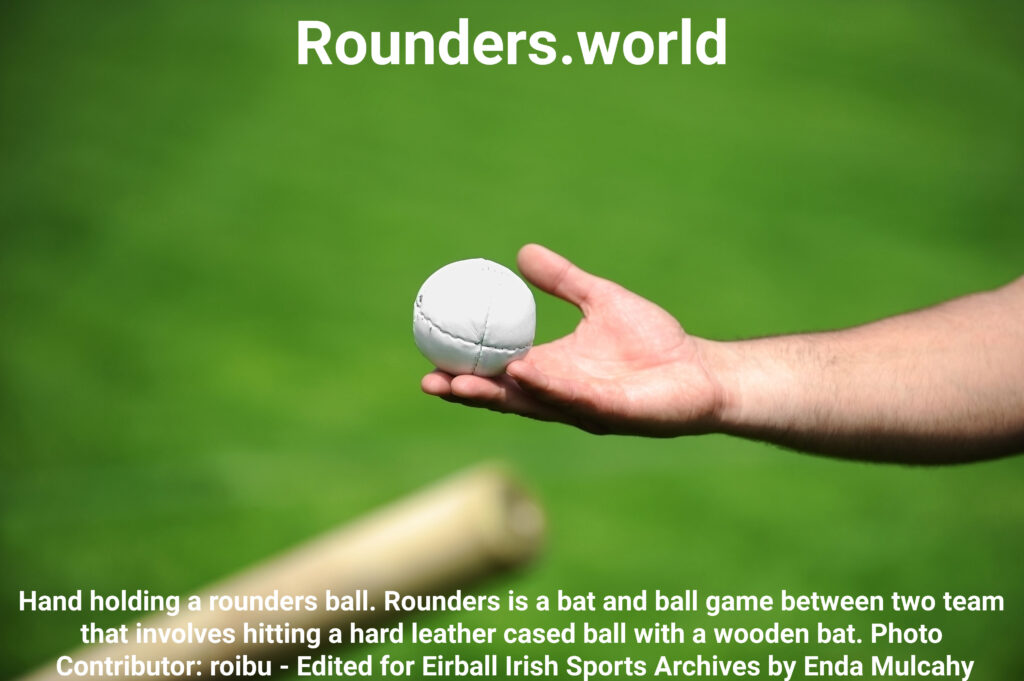
Photo Credit: roibu Hand holding a rounders ball. Rounders is a bat and ball game between two team that involves hitting a hard leather cased ball with a wooden bat. [Internet] Available from: https://www.shutterstock.com/image-photo/hand-holding-rounders-ball-bat-game-277897988 [Accessed 19 February 2022][Last Accessed 30 December 2023][Edited for Eirball Irish Sports Archives by Enda Mulcahy 30 December 2023]
WLBU Premier Divison Overviews:
Welsh Ladies Baseball Union Premier Division 2012-2018
WLBU Premier 2019 Champions: Newport (24 Pts / 14 Games)
WLBU Division 1 Overviews:
Welsh Baseball Union
Welsh Baseball Union
Photo Credit: roibu Hand holding a rounders ball. Rounders is a bat and ball game between two team that involves hitting a hard leather cased ball with a wooden bat. [Internet] Available from: https://www.shutterstock.com/image-photo/hand-holding-rounders-ball-bat-game-277897988 [Accessed 19 February 2022][Last Accessed 30 December 2023][Edited for Eirball Irish Sports Archives by Enda Mulcahy 30 December 2023]
WBU Premier Division (Overviews):
Scandinavian Baseball
Scandinavian Baseball (Pesäpallo, Brännboll) are Baseball games that are closer to Rounders than the Modern American Sport, and although Pesapallo (Finland’s National Sport) has been modernised a great deal, the other Scandinavian versions of the sport (e.g. Brännboll) are very much still traditional sports like Rounders and would undoubtedly have the same roots.
Finnish Pesäpallo
Pesäpallo is the Finnish version of Baseball and is their National Sport. It has an unusual form of pitching and players run zig-zags through bases. There is a game played on their National Holiday every year at the Finnish Embassy in Ireland.
Here is a Video of the sport from the New York Times, as shared by the Irish-Finnish Society on Facebook https://www.facebook.com/IrishFinnishSociety/posts/1326676680678956 [Accessed 27 June 2019]
Pesäpallo (Finland)
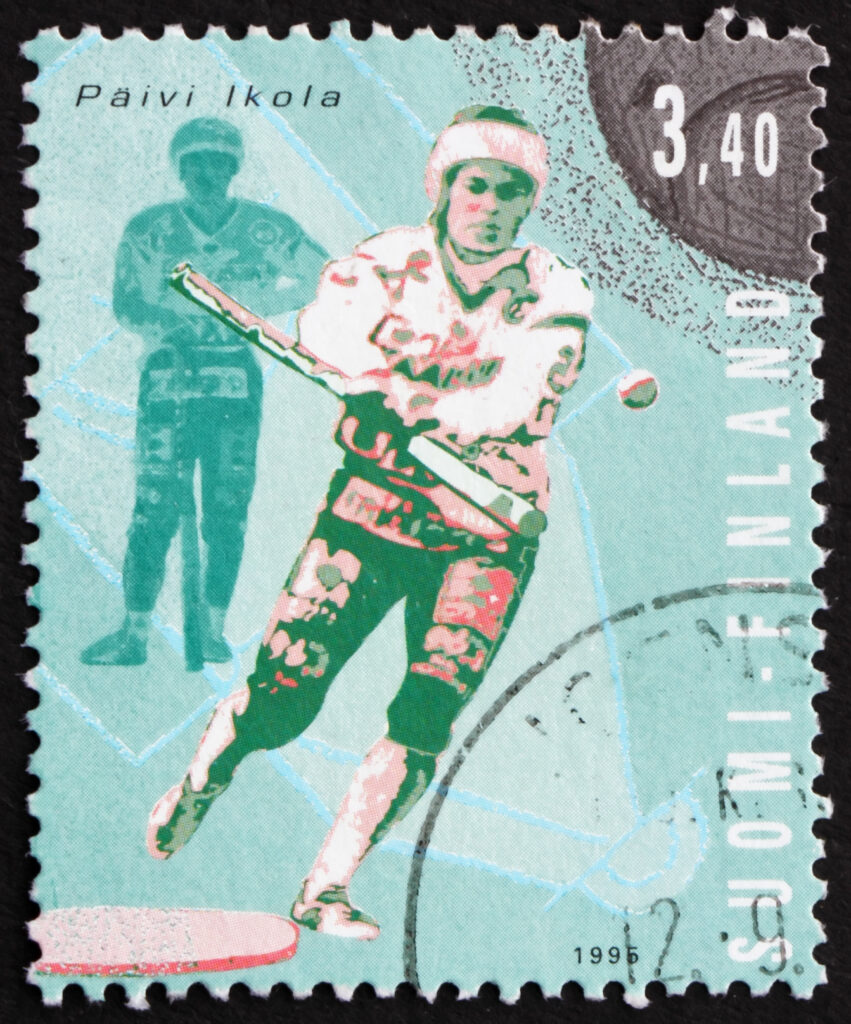
FINLAND – CIRCA 1995: a stamp printed in the Finland shows Paivi Ikola, Pesapallo Player, National Sport of Finland, circa 1995 ©boris15/123RF.COM
Finnish Pesäpallo Super Pesis:
Finnish Pesäpallo Super Pesis:
Finnish Pesapallo Superpesis Men 2019
Irish Pesäpallo Matches
Pesapallo on Independence Day at the Finnish Embassy in Ireland 6 December
Swedish Brännboll
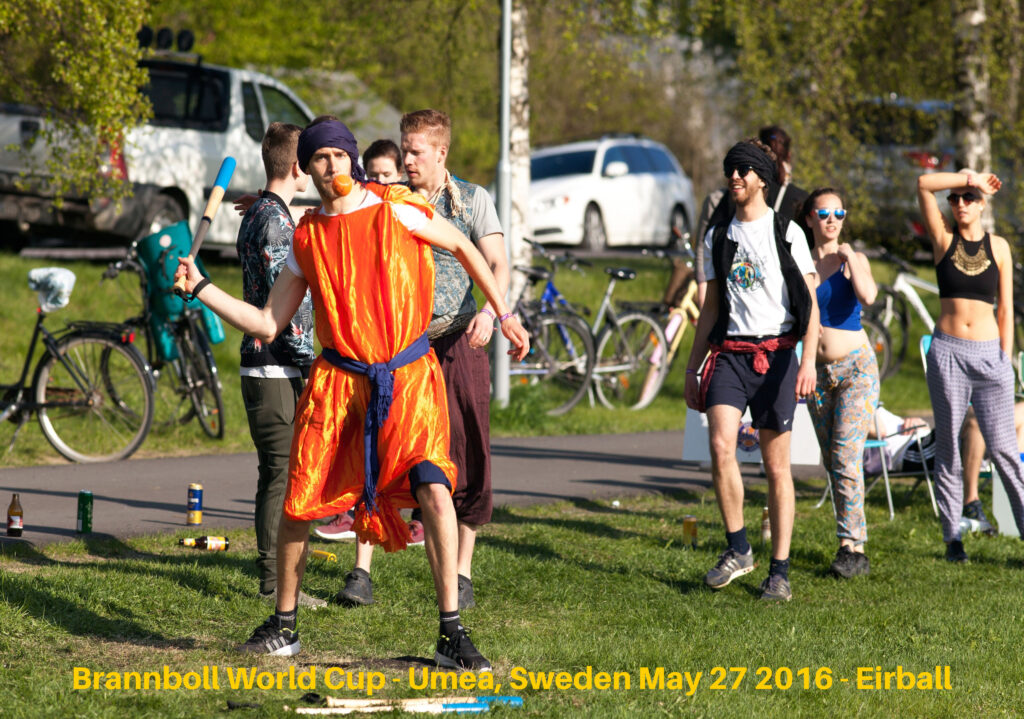
Brännboll is a traditional Swedish game similar to Baseball and Rounders. The Brännboll Cup, sometimes known as Brännboll World Cup is held every year at the Brännbollsryan Music Festival at Umea, the largest Music Fesitival in Northern Sweden.
Brännboll World Cup
Photo Contributor: Scandphoto (2016) UMEA, SWEDEN ON MAY 27. Unidentified participants in the Brannboll on May 27, 2016 in Umea, Sweden. Imaginative costumes. [Internet] Available from: https://www.shutterstock.com/image-photo/umea-sweden-on-may-27-unidentified-2182718309 [Accessed 26 July 2022]
Brännboll World Cup
Final 2019: Salming 74 Burnouts 72
Calcio Storico Fiorentino
World Football on Eirball includes Football varieties played in East Asia, Aboriginal Australia, Africa and Old Europe.
This is the Eirball – World / Irish North American and World Sports Archive landing page for Calcio Storico Fiorentino, one of the earliest forms of organised football in the world, and which bears a striking resemblance in play to Gaelic Football, as well as a shared Atlantic heritage in a pre-Roman/pre-English, pre-Catholic Rennaisance or Revival. To view results of Calcio Fiorentino just click on the links in red/blue (purple) below the introduction.
This is the GAA World (Eirball) Landing page for the All-Time Results of Calcio Fiorentino.
Header Picture Credit: [1] MONACO – CIRCA 1963: A stamp printed by MONACO shows an illustration of the Calcio Fiorentino field and starting positions from a 1688 book by Pietro di Lorenzo Bini, Florence, circa 1963 By Sergey Goryachev / www.shutterstock.com
Renaissance European Football
First codified in Renaissance Florence (Tuscany, Italy), Calcio Storico Fiorentino is still played in Florence. Resembling a more brutal version of Gaelic Football, it is the oldest codified football game in the world. Other codified versions of European Football which bear a similarity to Gaelic Football include Lelo (also known as Lelo Burti) in Georgia, on the borders of Eastern Europe and Asia.
Calcio Storico Fiorentino
This is the Eirball – World / Irish North American and World Sports Archive landing page for Calcio Storico Fiorentino, one of the earliest forms of organised football in the world, and which bears a striking resemblance in play to Gaelic Football, as well as a shared Atlantic heritage in a pre-Roman/pre-English, pre-Catholic Rennaisance or Revival. To view results of Calcio Fiorentino just click on the links in red/blue (purple) below the introduction.
This is the GAA World (Eirball) Landing page for the All-Time Results of Calcio Fiorentino.
Header Picture Credit: [1] MONACO – CIRCA 1963: A stamp printed by MONACO shows an illustration of the Calcio Fiorentino field and starting positions from a 1688 book by Pietro di Lorenzo Bini, Florence, circa 1963 By Sergey Goryachev / www.shutterstock.com
Calcio Storico Fiorentino is a Renaissance Football game first played in Florence (Fiorentina), Tuscany in the 1400s by workers on breaks from work in the city. It was the first organised football in the world, rather than the Medieval mob football which preceeded it and where there were no rules or restrictions on numbers playing. It could be seen as part of the wider Renaissance whereby Tuscany’s ancient pre-Roman, pre-Catholic past was brought back.
The earliest orgainsed Football matches anywhere in the world, as far as Eirball has discovered, although earlier reports in Ancient Europe, Greece, Rome, Italy and China mention similar games, though of what nature is hard to discern – they may just have been children’s catching games. [See articles on Medieval Football at: Medieval Celtic Sports for more information and references on this]
*The Tuscan language (Etruscan) is one which predates the Latin arrival in the Italian peninsula, and even though the letters and sounds are known there is no knowledge of the word meanings as no document translating Etruscan to Latin or Greek has ever been found. It does, however, sound similar to Basque, and therefore could be incuded in the Celtic sports section as part of the “Atlantic” or “Black Atlantic” family along with the Celtic languages, Basque and Berber (Tamashek) – half the words in the Gaelic language are of an Indo-European origin (Greek, Latin, Germanic, Slavic etc)and half of a North African Afro-Asiatic origin (Berber, Tuareg, Maltese, Hebrew, Arab etc).
[References: [4] Calcio Storico Fiorentino Sito Ufficiale (2020) CALCIO STORICO FIORENTINO [Internet] Available from: http://calciostoricofiorentino.it/?q=calcio-storico-fiorentino [Accessed 4 August 2020] and [5] Calcio Storico Fiorentino Sito Ufficiale (2020) Studies & Documentation [Internet] Available from: http://www.calciostoricofiorentino.it/?q=studi_e_documentazione [Accessed 4 August 2020]
Calcio Fiorentino (Tuscany)
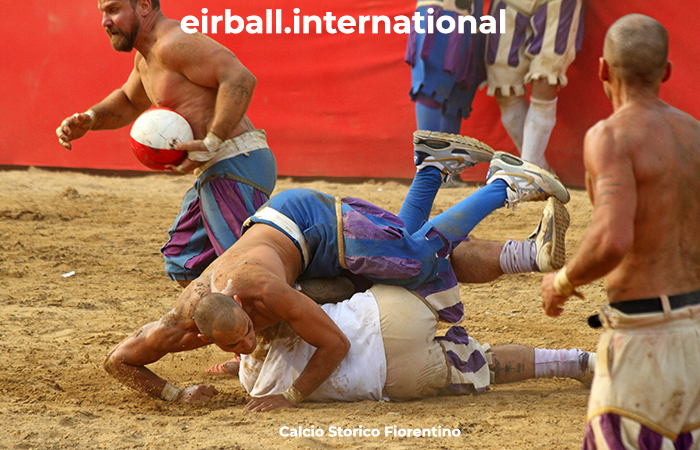
FLORENCE – JUN 24: Fighting players during Calcio Fiorentino match on June, 24,2012. Calcio fiorentino (calcio storico or calcio in costume) is an historic florentine game, origins of modern football Copyright: mkistryn
Calcio Fiorentino
A Medieval Football game, first organised in Renaissance Florence, Tuscany, Italy, that was first played by workers between breaks in work, and then organised matches beginning in 1530.
The earliest orgainsed Football matches anywhere in the world, as far as Eirball has discovered, although earlier reports in Ancient Europe, Greece, Rome, Italy and China mention similar games, though of what nature is hard to discern – they may just have been children’s catching games. [See articles on Medieval Football at: Medieval Celtic Sports for more information and references on this]
Calcio Storico Fiorentino
Calcio Storico Fiorentino Finals 1952-Present
Calcio Storico Fiorentino (Seasons):
Calcio Storico Fiorentino (Seasons)
2023 Champions: Rossi
2022 Champions: Azzurri
2020 Champions: None (Cancelled due to Covid)
Calcio Storico Fiorentino August Festival (Seasons):
Calcio Storico Fiorentino Teams
[References: see Encyclopedia Brittanica sections on Indo-European, Celtic, and Afro-Asiatic languages: Encyclopedia Britannica | Britannica ]
Lelo Burti (Georgia)
Lelo Burti is the traditional Georgian form of Rugby, Gaelic or Medieval Football
Lelo Burti (Georgia)
[1] Lelo Burti (2016) Logo_ [Internet] Available from: https://web.archive.org/web/20160923010826im_/http://lelo.comyr.com/images/Logo_.jpg [Accessed 24 August 2020]

Lelo Burti (Georgia)
Lelo Burti
Lelo Burti is the traditional Georgian form of Rugby.
Georgia: Lelo Burti
SLF Samegrelo Region Championship (seasons):
Choule Crosse Normande
The Traditional Sports and Games of Normandy (North France) were first described in the 12th Century A.D. Choule is a Team Sport involving a curved stick and a leather ball.
Choule Crosse (Normandy)
Picture Credit: [1] Fédération de Jeux et Sports Traditionnels Normande et Vikings (2014) logotradinormandiedetoure [Internet] Available from: https://jeuxtradinormandie.files.wordpress.com/2014/11/logotradinormandiedetoure.png [Accessed 23 October 2020]

Jeux et Tradi Normandie
Choule Crosse Normande
FJSTNV Choule Crosse Normande (Seasons)
The Logos and Photos used in this article remain the property of the organisations and individuals which own the copyright and are used here for educational and information purposes only.
Citations and References
References: [1] BBC Cornwall (2003) Hurling at St. columb in the 21st Century [Internet] Available from; http://www.bbc.co.uk/cornwall/villages/stories/stcolumb_hurling.shtml [Accessed 7 March 2018]
[3] St. Ives Web Community TV (2013) The St. Ives Feast and the Silver Ball [Internet] Available from: https://web.archive.org/web/20130819100810/http://stivestv.co.uk/whatson/feast_day_2013.htm [Accessed 13 June 2019]